
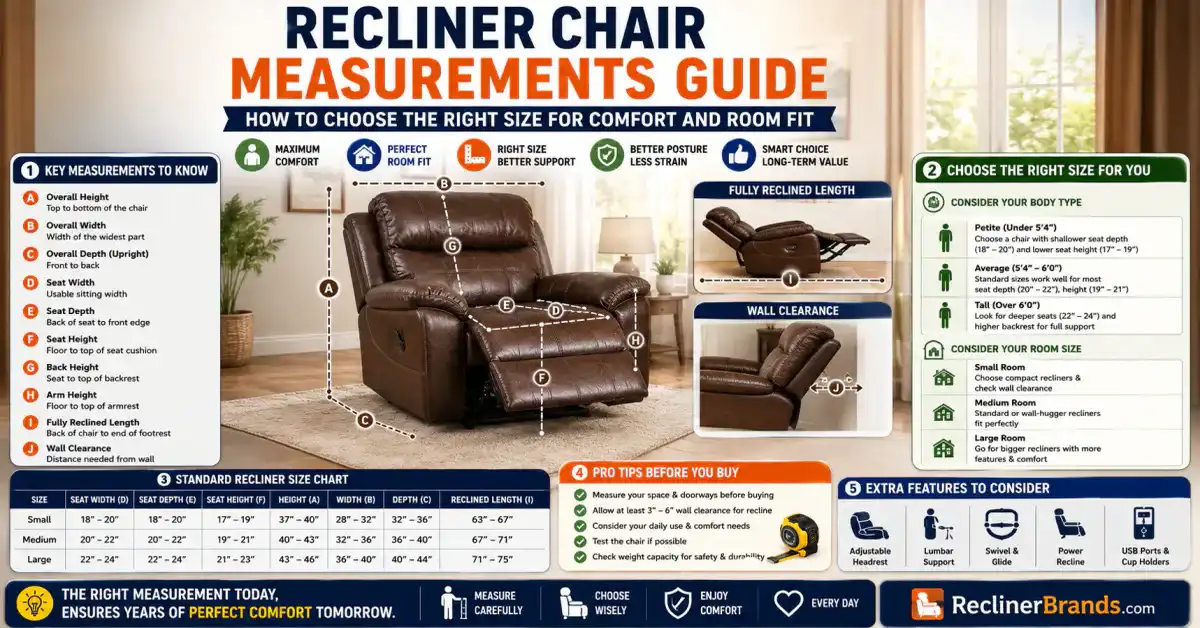
When buying a recliner, most people focus on fabric, color, cushioning, and reclining features. But our team has been reviewing various recliner models, user feedback, and recliner chair measurements. Our team has found that the most common cause of regret is not the design, but incorrect measurements.
In many cases, even though the chair looks perfect, the seat depth, backrest height, or reclined length does not fit the user’s height, sitting style, or room layout. It also turns out that after bringing the recliner home, it takes up much more space than expected. In this guide, our team will show you which measurements to look at first. Which are the most overlooked and how to check the room fit before buying a recliner.
Many Recliner Chair Buying Guides discuss features. But a few inches of measurement difference can often make the difference between a comfortable recliner and an uncomfortable recliner.
Why Are Recliner Measurements Important?
A chair may look good, but if it has the wrong seat width, seat depth, or seat height, it can be uncomfortable to use. Large recliner dimensions can also reduce the amount of floor space needed in a room.
For this reason, it is important to check a few important measurements before purchasing.
Better Comfort, Support, and Posture
Our team has noticed, while testing different recliner chairs, that the right-sized chair has a huge impact on the user experience.
The right seat width ensures a comfortable seating position. The right seat depth provides good thigh support. The right seat height helps keep your feet naturally on the floor.
The height of the backrest is also important. The back, neck, and head are well supported. The difference is huge when sitting for long periods.
A properly sized recliner chair usually provides good comfort and support, making the sitting experience more natural.
Choosing the Right Size for Your Room
Our team has made another common observation. Buyers often consider the chair’s size in the sitting position. But they don’t consider how much space it will take up in the fully reclined position.
As a result, space issues can arise after installing a new recliner in the home.
Please check the room size, available space, and full recliner dimensions before buying. Usually a wall-hugger recliner works well in small living spaces or family rooms.
Measure doorway clearance, hallways, and delivery path in advance. This can prevent any unforeseen problems on the day of delivery.
Measuring the User: Finding the Right Fit for Your Body
The most important step before buying the best recliner chair is to know your body size. Our team has often seen that even if the design or features are good, if the measurements are wrong, the real comfort is not achieved.
Again, if the recliner dimensions exceed the room dimensions, the required living space is reduced. This is why it is important to get the right size according to your body from the beginning.
Seat Width Making Sure You Have Enough Sitting Space
Our team has seen this repeatedly when working with seat width. It is directly related to sitting comfort. A little more or less width can change the whole feeling.
With the right seat width:
- The body does not feel pressure on either side
- You can move naturally while sitting
- The armrests are easy to use
- There is less discomfort when sitting for a long time
A recliner that is too narrow restricts the body. And if it is too wide, the body does not stay still properly. Our team always focuses on getting this balance right.

Seat Depth Supporting Your Thighs Without Pressure
The team’s most common problem with seat depth is that when it’s incorrect, the user unknowingly leans forward. This changes the entire posture and reduces back support.
With the correct recliner chair depth measurements:
- The thighs sit comfortably
- There is no pressure behind the knees
- The body naturally sticks to the backrest
Even after sitting for a long time, the sitting posture remains stable
If the seat is too deep, the back does not sit properly. And if it is too shallow, the thighs do not get proper support. Both of these conditions create discomfort.
Seat Height: Keeping Your Feet Flat on the Floor
Our team has observed seat height. It has been found to have a major impact on body balance and daily comfort.
With the right seat height:
- Feet are naturally on the floor
- Knees and waist are in a comfortable position
- It is easier to sit and stand
- Sitting for a long time is less tiring
If the seat is too high, the legs hang down. And if it is too low, the knees are put under pressure. Therefore, it is very important to keep the height balance right.
Backrest Height Supporting Your Back, Neck, and Head
A good backrest is not just for the back. It supports the entire upper body. In our experience with regular recliner users, the best comfort is attained when the backrest gives good support to the neck and head.
Correct height of the backrest:
- Provides comfortable back support
- Reduces neck strain.
- The head is resting naturally
- It is easier to sit for long times
This is particularly important for those who watch TV or study.
Armrest Height Helping Your Arms Stay Relaxed
Armrest height may seem like a small thing, but it has a big impact on the overall seating experience. Our team has found that incorrect height can quickly lead to shoulder discomfort.
With the correct armrest height:
- Shoulders are naturally relaxed
- No extra pressure is placed on the arms
- The body is in a balanced position
- Posture is correct while sitting
Using an armrest that is too high or too low can quickly lead to shoulder discomfort. This is something many users may not realize at first.
Measuring Your Room Space, Layout & Fit
It is often difficult to tell whether a recliner chair will fit in a room just by looking at it in a store. Our team has seen while working with various living room setups that the actual condition of the space can only be understood after placing the chair in the room. Not only does it change the comfort, but the use of the room changes.
So it is important to consider not only the size, but also how the chair will be used in the room.
Total Space Needed Closed vs Fully Reclined Size Difference
A recliner takes up more space when reclined than it does when seated. Our team has observed across various setups that this is the area where mistakes most often occur. Because many people make decisions based solely on the recliner’s size.
Having some basic measurements in mind beforehand can help reduce the problem:
- It is best to leave 12–18 inches of space from the wall
- Fully reclined position requires about 60–72 inches of space
- A small room needs at least 7×7 feet of open space
If you don’t take this into account, you’ll find that the chair is pushing against the wall. The space in front is reduced.
Wall-Hugger Recliners Better Fit for Tight Spaces
Not all recliners are the same. Our team found that wall-hugger recliners are more useful than regular recliners in small or cramped living spaces.
This type of chair reclines by sliding forward instead of backward. That makes it the best recliner for small spaces.
- What our team found most
- Works best when spaced 4–6 inches from the wall
- Works best in small apartments
- Less space in small living rooms
Walkway & Movement Space: Keeping the Room Open
It’s not enough to just place a recliner in the room. You also need to keep the space for movement right. Our team has seen that even when the chair is in place, reducing the walking space makes the room difficult to use.
Keeping some minimum space makes it easier to use:
- Main movement space: 30–36 inches
- Minimum in a small room: 24 inches
- It is better to keep 18–24 inches of space with other furniture
If these are not in place, the room looks heavy and small.
Power Recliners Outlet & Placement Planning
Using a power recliner or rise recliner chair is not just about space. It is also important to consider the power setup in advance. Our team has seen that many people later realize that the power outlet is not in the right place.
Some things to consider in advance make it easier to use:
- It is better if the power socket is within 6–8 feet
- Is USB charging easy to use
- Can a 10–15 feet extension cable be used if necessary
If everything is in order, it is much easier to use, and there is no unnecessary hassle at home.

Understanding Recliner Sizes and Weight Limits
The right recliner size, adequate weight capacity, and good seat support have a big impact on long-term comfort and durability. Our team reviewed various recliner dimensions and user experiences. Choosing the wrong size can make even the best chair feel uncomfortable.
Small, Medium, and Large Standard Recliner Size Guide Charts
Not all recliners are the same size. It is necessary to choose the right size based on the user’s height, body structure, and the available space in the room. Our team has found that many people only consider the chair’s outer dimensions. But do not pay too much attention to seat width, seat depth, seat height, and backrest height.
The chart below will serve as a useful reference for common standard recliner measurements.
| Size Category | Seat Width | Seat Depth | Seat Height | Backrest Height | Recommended User Height |
| Small | 18–20 in | 19–21 in | 17–18 in | 38–42 in | 5’0″–5’6″ |
| Standard | 20–22 in | 20–22 in | 18–19 in | 40–44 in | 5’4″–5’10” |
| Medium | 20–23 in | 21–23 in | 18–20 in | 42–46 in | 5’6″–6’0″ |
| Large | 23–26+ in | 22–25 in | 19–21 in | 46–50+ in | 6’0″+ |
What Our Team Noticed
While working on recliner dimensions, our team often noticed one thing. Many buyers pay attention to the seat width. But seat depth is often not considered important. Later, it was observed that if you sit with your back completely against the backrest, discomfort develops behind the knees. Your feet cannot be placed naturally on the floor. In reality, if you want to sit comfortably for a long time, seat depth is no less important than seat width.
User Weight Capacity and Strong Frame Support
Weight capacity and frame strength are directly related to the long-term comfort, durability, and safety of a recliner. While looking at different recliner models, our team noticed one thing. Many buyers are looking for the fabric, features, or appearance. But they do not pay much attention to the chair’s inner structure. But a lot of the long term goodness of a chair is built on this foundation.
- Standard Capacity: Most standard recliners are built to hold 250-300 lbs.
- Heavy-duty options: Larger or reinforced models can hold 350 to 500 pounds or more.
- Frame Construction: Solid hardwood or reinforced steel frames are more stable and durable.
- Reclining mechanism quality: The more robust the reclining mechanism the better it will stand up to daily use.
- Everyday Use
The quality of the frame and support systems is even more critical in recliners for everyday use.
- Improved Stability: Its robust frame provides increased stability and reduces any undesired motion.
- Long-Term Reliability: If the components are good and the construction is good, the chair will last long.
- Greater weight capacity :
Some models with a greater weight capacity have reinforced brackets, stronger springs and other supportive components.
- Power recliner support the power recliner support is constantly utilising the motor and the reclining mechanism. So a benefit here is a good frame.
- A Little Extra Capacity Helps: We generally suggest our team choose a recliner that can hold a bit more weight than the actual user weight. This prevents undue stress on the frame and mechanism every day.
What Our Team Noticed
Our team has noticed one thing repeatedly when comparing different recliners. A new recliner almost always feels comfortable. The real difference is noticeable after a few months of regular use. This is where you feel the quality of the frame, the stability of the support, and the continued smooth operation of the reclining mechanism. So when choosing a recliner, don’t just look at the exterior design. The interior structure is just as important.
Why High-Density Foam and Seat Support Matter
Many times, two recliners look almost the same. But the seating comfort is not the same. The main differences are the high-density foam and the seat support.
Our team has noticed that a good recliner does not just give a soft sitting feeling. How naturally it can support the body is more important.
- High-Density Foam: Even after long-term use, the shape remains quite stable. So the chair does not sink quickly, and the support is provided as before.
- Foam Quality: After a few days of use, it becomes soft. And so the comfort doesn’t feel like it used to.
- Seat Support: It spreads the body weight across the entire seat so it’s not concentrated in one area. So sitting is more level.
- Hip & Lower Back: Reduced pressure on the waist and hips, allowing for longer sitting periods.
- Long sitting comfort: Body doesn’t get tired easily even if you sit for longer periods.
- Daily Use Stability: Even if you use it every day, the sitting feeling remains pretty much the same.
- Seat Base Strength: A strong lower structure makes for a more stable chair overall.
- Lumbar Support : Keeps the back straight, so posture is correct.
- Pressure Build-up: Less pressure builds up on the body even after sitting for a long time.
- Real-Use Difference: It’s obvious when a chair supports you well.
What Our Team Noticed
Our team has found that new recliners always seem comfortable at first. However, after a few days of use you can really see the difference. Then you can see if the foam is still present. If the seat support is working properly. If you feel uncomfortable sitting for a long time. So when buying a recliner, it is more important to focus on the foam and internal support than on the design alone.
Technical Features: Manual vs Power Systems

Manual vs Power Operation: Space & Ease of Use
The difference between manual vs power recliners is clearer when you use them. Manual recliners usually work with a lever or handle. So they have few parts and take up relatively little space. They are easy to install in small rooms or limited spaces.
Power recliners offer a completely different experience. The position changes as you like at the touch of a button. But here you have to keep a little more space, especially when fully reclining the back.
| Feature | Manual Recliner | Power Recliner |
| Space Requirement | Low | Medium–High |
| Small Room Fit | Better | Moderate |
| Operation | Lever/Handle | Motor/Button |
| Reclined Clearance | Less space needed | More space needed |
| Ease of Use | Moderate effort | Very easy |
When our team worked with various recliners, one thing kept coming to mind again and again. It is much easier to install a manual chair in a small room or in a space with less space. And when installing a power chair, it is important to measure the space beforehand. Otherwise, problems arise when fully reclining.
Lift Chairs and Riser Recliners: Seat Height & Standing Support
Lift chairs or riser recliners are mainly for those who need a little more help getting up from a sitting position. The real issue here is the seat height.
Our team’s experience is that if the seat is a little low, it is hard to get up. On the other hand, if it is too high, the feet do not have good contact with the ground. This small mismatch often leads to big trouble. When the height is right, standing up from sitting feels quite natural and stress on the body is also reduced.
Dual-Motor Recliners: Adjustable Position & Body Alignment
The dual-motor recliner has individual controls for the backrest and footrest. Sounds simple but makes a huge difference when in use.
Our team has noticed that everyone finds their own comfortable position in this type of chair. Some sit a little more reclined. Some spend a long time sitting upright. In fact, this flexibility provides comfort to the body during long sitting. It prevents pressure from accumulating in one place.
Material Selection and Longevity
While working on recliner chairs, our team’s clearest observation was that even when the design is the same, changing the material can alter the entire seating experience. Many chairs look the same at first. But after using them for a few days, you can see the difference in fabric, comfort, and durability.
Upholstery Choices: Leather, Microfiber, and Polyester Fabrics
leather
The team’s experience with leather recliners is that they look more premium and is easy to clean. Can be wiped with a soft cloth.
However, it retains some heat when sitting in a hot environment. This is felt after long use.
Microfiber
For many users, microfiber is more comfortable. Because it gives a soft feel. It adjusts easily to the body. It also collects less dust in daily use. So maintenance is relatively easy.
Polyester fabric
Comment from the team on polyester fabric: It’s a very practical choice. It stains less and holds its shape fairly well with heavy use. But in the end, which one you like best depends more on the user’s daily habits and comfort preferences.
Wear Resistance Factors: Jacquard Weave and Double Rub Rating
The team has observed that the Jacquard weave is a dense structure that helps the fabric to maintain stability even after long-term use. Appears simple, but its durability is evident after use.
In the case of a double-rub rating, it has been observed that when the rating is low, the fabric starts to feel dull or worn after a few days of use. And if the rating is high, it can handle the friction of daily use much better, and the chair will last longer.
Care and Cleaning Tips for Long-Term Use and Hygiene
- According to the Leather Recliner Team, the easiest maintenance is to wipe it regularly with a soft cloth to keep it clean
- Any fabric can fade in direct sunlight. We have observed this repeatedly
- A soft brush or light vacuum on microfiber fabric will easily remove dust
- Polyester fabric will gradually build up dirt if not cleaned regularly
- Overall hygiene is much better with occasional deep cleaning
- Those who do basic care regularly will find their recliners stay in good condition for a long time
If you are looking for the best recliner for back pain, you can check out this guide from our team. Recliners suitable for sitting comfortably for a long time have been discussed in detail.
When to Consult a Professional: Bespoke Seating Solutions
In many cases, recliner chairs can be easily chosen to suit your needs. But as our team has repeatedly found, in some situations, following simple measurements or basic guidelines does not solve all problems. Then it is necessary to think a little differently. For whom is the chair intended, how is it used, and what kind of support does the body need?
The Role of an Occupational Therapist in Meeting Clinical Requirements
Occupational therapists typically work with people who have physical limitations in sitting or standing. Our team has noticed that in such situations, recliners are not just comfortable furniture. Rather, they become part of everyday mobility.
The therapist observes the user’s body to determine the appropriate seat height. What kind of back support is needed, and how much recline should be. This reduces discomfort during use and allows the body to receive more natural support on its own.
Home Assessments and Working with a Seating Specialist
Sometimes it’s not enough to just choose a chair. You also need to consider the space in the room. Our team has seen, in various cases, that when a seating specialist reviews the room and makes a decision, the entire setup becomes much more practical.
But where the hell will the chair sit at this point? What a place that will be! And the user is going to sit and stand? We’re looking at it together. This greatly reduces the hassle of space constraints or positioning errors later on.
Addressing Complex Needs: Pelvic Tilt and Pressure Ulcer Prevention
For some users, the problem is a little more sensitive. Especially if pressure builds up in certain areas of the body after prolonged sitting. From our team’s experience, we have found that a regular re
Here, the seat angle, padding, and support are adjusted so that the body’s weight is distributed over the entire seat. In this way, the body does not become heavy even after long hours of sitting, reducing discomfort.
Practical Tools for Your Shopping Trip
When buying a recliner chair, many people initially make their decision based on the design or online pictures. But our team has seen, from working with various buyers, that the biggest problems later on are space and actual fit. So, if you do a little preparation before buying, the whole thing becomes a lot easier.
Your Measurement Kit: Measuring Tape, Notes, and Camera
Before buying a recliner, a simple measurement setup is most useful. A tape measure, small notebook, and mobile camera are all you need to get a clear idea of your room.
Our team has repeatedly observed that many people make decisions based on showroom or online looks when buying a chair. But after bringing it home, they find that the space is less. When fully reclining, there is an obstacle in the back. So, it is not just the size of the chair.
How much distance is there from the wall? How much space is there in front? All these need to be measured in advance. Writing them down makes it easier to compare different models and reduces confusion.
How to Understand Product Details and Size Information Online
Seat width, depth, height, and fully reclined length are typically found on online product pages or spec tags. With these measurements, you will be able to calculate the real space.
Our team’s observation is that the biggest mistake is to make a decision based only on the seat width. Later, it turns out that when the chair is fully reclined, it is against the wall or the back space is gone. Therefore, each dimension needs to be considered together, not separately.
Understanding Return Policies and Shipping Charges
It is very important to check the return policy and shipping charges before buying a recliner. Because it is a small product and not a large furniture item. Sometimes the delivery cost varies. The return time is limited.
Our team has seen that many buyers skip this part. Later, problems arise with delivery or return. So, it is safest to clarify the delivery time, return conditions, and any extra charges in advance.
Comparing Multiple Models Before Final Decision
It is not right to make a final decision based on a recliner. In our experience, comparing 2–3 models will help you understand which one best fits your room and daily use.
Even if it is the same type of chair, the seat depth, back support, and recline range may differ. A side-by-side comparison will help you determine which one is more comfortable for long-term use. It will match better according to the space.
Special Recliner Sizes for Different Spaces and Body Types
Not all recliners are made for the same type of user or room layout. In reviewing different recliner chair measurements, our team found that not only the cushioning or reclining mechanism, but also the overall size of the chair plays a significant role in comfort. A small recliner for a small apartment might be just right. But the same chair may not support a taller user enough. So besides knowing the common recliner chair dimensions, it’s also important to learn how the different size categories are actually used.
Compact, Mini and Space-Saving size specifications for recliner chairs
If you’re choosing a recliner for a smaller room, the two most important factors are the space you have and the chair’s actual footprint. A product description of compact doesn’t mean it’s okay for all small spaces. Also consider how much space the chair will take up when reclined and how it will fit with the surrounding furniture.
Mini reclining chair
Mini reclining chair measurements typically range from 18–20 inches seat width. They range from 19–21 inches seat depth and about 60–65 inches reclined length. When comparing different models, it is clear that this category fits easily into a bedroom corner, reading nook, or a little lounge. However, in some instances, taller individuals may desire additional leg support or a deeper seat.
Space-saving Recliner
Space-saving recliner sizes typically have a 19–22-inch seat width and a fully reclined length of about 65–70 inches. One thing became clear when analyzing compact living rooms. Afew inches less footprint can actually create a lot more free space. This is why space-saving models are popular in many apartments and smaller living areas.
Recliner Size For Small Rooms
When evaluating recliner size for small rooms, simply looking at the chair’s width doesn’t tell the whole story. In general, a workable option for a small room is a model with a 20-22 inch seat width and an overall reclined length of 65-72 inches. Depending on the room layout, reclined length can sometimes be more important than seat width, as there needs to be enough room to move around even when the chair is unfolded.
Small apartment recliner
The situation can be different in apartment living. When looking at small apartment recliner specifications, it’s important to consider not only the living room space, but also delivery access. When reviewing real setups, it’s been found that checking for a 30–36-inch doorway clearance in advance can avoid many common problems. Many compact models are designed with apartment environments in mind, simplifying installation.
What Our Team Noticed
While comparing different compact recliners, our team repeatedly noticed one thing. People usually imagine how much space a chair will take up when it is closed. But in reality, recliners are used most of the time when they are open. As a result, reclined length and walking clearance ultimately have the biggest impact on room comfort and usable space.
Large, Big and Tall, and Plus-Size Recliner Dimensions
A standard recliner is sufficient for many users, but not for everyone. A review of various large recliner chair sizes, oversized models, and extended-dimension recliners shows that taller users or users who prefer extra seating room often feel more comfortable in the larger category.
large recliner chair
Large recliner chair sizes typically come in 23–26-inch seat width, 22–25-inch seat depth, and 46–50-inch back height. When measuring various large models, it was found that those whose head or shoulders do not get full support in a standard recliner often feel more comfortable in this category. The extra seat depth helps keep the legs in a more natural position during long periods of sitting.
Big And Tall Recliner
Big and tall recliner chair sizes typically have a seat width of 24–28 inches. They have a seat depth of 23-26 inches and a weight capacity of around 350-450 lbs. When analyzing the recliner preferences of taller users, it was found that backrest height is often more important than seat width. This category is usually designed with that in mind, and many models use a reinforced frame.
Plus-Size Recliners
When considering the dimensions of plus-size recliners, don’t just look at the overall size. Most models have a usable seat width of about 26 to 30 inches. Weight capacity of Seen 1,100 400–500 lbs. Now if you compare different specifications, one thing becomes clear. The usable seating area depends on the design of the armrests. This means that the total width given on the specification sheet and the actual seating space available are not always the same.
Giant Reclining Chair
Giant Reclining Chairs are usually classified by their biggest seating space. Here, the seat width is 28 to 34 inches, the seat depth is 24 to 28 inches, and the back height is 52 to 58 inches. Best for those who like to lounge or for those who spend a lot of time reading, watching TV or relaxing in a recliner and like the extra space. However, when fully reclined, this type of chair can take up about 80–90 inches of space. Therefore, it is necessary to check the room dimensions in advance.
What Our Team Noticed
While working with oversized recliners, our team noticed something interesting. Many users initially focus on seat width. But after a few months of use, it turns out that backrest height, seat depth, and overall fit play a big role in their experience. When buying a recliner, think about room size, user height, and reclined length at the same time, not just one measurement, to avoid having to make adjustments later.
You can check out our detailed guide to know about cheap recliner chairs. Our team has discussed various options that offer a good combination of comfort, quality and necessary features within a low budget.
Which Recliner Size Fits Your Height?
The user’s height affects recliner comfort. The same chair may be comfortable for one person but too deep in the seat or too short in the backrest for another. Studies have shown that recliner chairs are more comfortable when the chair size matches the user’s height. Taller users generally prefer a deeper seat and higher backrest. Shorter users are more comfortable with compact dimensions.
- Under 5’4″ for Mini / Small Recliner
- 5’4″–5’10” for Standard Recliner
- 5’10″–6’2″ for Large Recliner
- Over 6’2″ for Big & Tall Recliner
The height range can be a good place to start for many when narrowing down recliners. It’s easier to find the option you prefer when you compare different models, looking at height and chair dimensions together.
If you are looking for the best Recliner for Tall person, this guide from our team is for you. Some of the best Recliners for taller users have been highlighted in detail.
Understanding Recliner Space Requirements in Real Rooms
In our team’s experience, looking at different room layouts can result in a few inches difference in furniture placement, walking space, and overall room flow. While dimensions may seem close on paper, the actual usable space in a room may be more or less.
- A mini recliner with a reclined length of about 60–65 inches usually fits easily into a bedroom corner, a reading area, or a compact seating space.
- A standard or space-saving recliner with a reclined length of about 65–72 inches fits well with most living room layouts.
- Large recliner with a reclined length of about 75–85 inches needs to have adequate walking clearance in front.
- Giant recliner with a reclined length of about 80–90 inches or more can take up significant floor space, and room measurements should be verified before placement.
Why Weight Capacity Is Just as Important as Size
Many users pay more attention to the width, depth, or height of a recliner. weight capacity is relatively less important. But a lot of the chair’s rated capacity has to do with frame durability, how well it reclines and how well it holds up over the long term. Size and support capability do not always increase in the same proportion, so it is necessary to read the specification sheet carefully.
- More often than not, a larger recliner does not translate to a higher weight capacity.
- The frame construction and the recliner mechanism are important for weight support.
- Plus-size and big & tall categories often have weight capacities of 350-500 lbs or more.
- Check the manufacturer’s weight limit to avoid frame stress and premature wear.
What Our Team Noticed
When it comes to choosing a recliner, it is best to consider the size of the room, height of the user, seat depth, height of the backrest and weight capacity all at the same time. In many cases the seat width is sufficient but the back support or weight rating is not entirely satisfactory for the user. When these factors are considered together before making a final decision, there is a much lower chance of regretting the size later.

Final Checklist: Getting Ready for Your Perfect Recliner Purchase
Our team always checks the last step of buying a recliner chair. Often, the model is chosen, but if the room space or usage does not match properly, problems arise later during use. This checklist is to avoid such mistakes.
- Measure the room space again
Our team’s real observation is that the biggest problem is when the chair takes up the most space when fully reclined. That is not calculated in advance. The distance from the back to the wall and the movement space in front must be measured.
- Compare the seat width and seat depth
If you decide based only on width, you often put pressure on your knees or back while sitting, because if the depth is not right, the body does not get proper support.
- Check the fully reclined length
How long the chair is when fully opened. If you are not aware of this, space conflicts can arise with other furniture in a small or medium room.
- Check the doorway and entry path
Our team has seen in various delivery cases that even if the chair is correct, it can be difficult to enter the room if the doorway or corridor is narrow. Therefore, it is important to measure the entry path in advance.
- Compare the comfort position once
By testing 2–3 models together, you can understand which recline angle naturally fits the body and provides comfort during prolonged sitting.
- Understand the return policy well
In case of any mismatch, it is necessary to know in advance whether an exchange or return is possible. This reduces unwanted risk later.
- Confirm delivery charge and timing
Our team has noticed that extra delivery costs or delays sometimes arise. Therefore, it is necessary to ensure all details are clear before placing the order.
- Choose the size according to daily use
Based on long-term experience, comfort depends entirely on the user’s daily sitting habits and duration of use. Therefore, the size should be selected accordingly.
Common Recliner Measurement Mistakes to Avoid
Our team has repeatedly noticed one thing. Although everything seems fine at first, once you start using it, it becomes clear that some important considerations were not taken into account in advance. The following points should be taken into account to avoid mistakes:-
- Deciding on Seat Width Only
Our team has often observed that many buyers consider seat width the most important measurement. But in reality, seat depth is just as important as width. Although width is comfortable, if the depth is not right, the sitting position can start to feel uncomfortable after a while.
- Not Looking at Fully Reclined Length
A chair that looks compact in the showroom or in the picture often takes up much more space when fully reclined. In our team’s experience, the most surprises about room space arise from not considering this measurement.
- Not Looking at Seat Depth
In many cases, seat depth is overlooked as it is in the middle of the list. But our team has found that if the depth is not right, the sitting position does not feel natural even after placing the back on the backrest, and it can also become difficult to sit for extended periods.
- Not calculating the clearance
Just knowing the chair’s size is not enough for a recliner. Our team has reviewed various room layouts and found that if there is not enough space at the back, the reclining feature cannot be fully utilized.
- Forgetting the Doorway and Entry Path
Many people think about where the chair will be placed. But how it will enter the room is not always considered. According to our team’s observation, it is very common to have problems with the doorway measurement on the day of delivery.
- Thinking that all standard recliners are the same size Many users assume that standard recliners mean the same type of dimension. In reality, there are significant size differences depending on the brand, design, and mechanism. Therefore, looking at the specifications is more reliable than guessing.
- Not thinking about how long the chair will be used
Our team has noticed that recliners are used for 30 minutes a day. For recliners used for several hours a day, the importance of measurement is not the same. The more use, the more important the correct fit becomes.
- Just make a decision based on the first few minutes of comfort
When you sit in a new recliner, almost any model may seem comfortable. But in our team’s experience, it takes a few months of use to realize how well the measurements, support, and seating position actually fit.
What Our Team Noticed
This is what we most commonly see in our team’s experience. Many users make a decision based on one or two measurements. Later, after starting to use it, they realize that room space, reclined length, seat depth, or sitting position should have been considered together. In reality, recliner selection is easiest when the entire measurement picture is viewed together rather than as separate numbers.
The real point of buying a recliner is not just the design or brand. It’s the fit. Our team has seen, through various recliner chair measurements, that users initially compare seat depth, backrest height, and reclined length. Take a look at the Recliner Chair Buying Guide.
This reduces the incidence of size mismatch later. Because a recliner works well only when it properly supports the body. And adapts well to the room’s space. So checking a few measurements before making a final decision is the most important step. Once you can match it correctly, a recliner is not just furniture. It becomes the most comfortable place to sit every day.
A standard recliner typically has a 20–22-inch seat width. 20–22-inch seat depth. Backrest height: 40-44 inches; reclined length approx. 65-72 inches. However, these measurements depend on the brand, design, and the recline mechanism. Thus, it is not possible to decide a specific standard size. It is always safest to compare the product specifications with the actual dimensions of your preferred model before you buy it.
When you measure a recliner, begin with the overall width, seat width, seat depth, seat height, backrest height, and armrest height. Then, with the chair reclined all the way, measure the length of the reclined chair and the needed wall clearance. Also measure the available room space, the width of the doorway, and the space allocated for where the chair will be placed. This will prevent any size surprises on delivery or installation.
Many people after rotator cuff surgery find that a recliner helps them sit or rest more comfortably, because it keeps the upper body elevated. But you don’t need the whole. Whether you need a recliner depends on the type of surgery, the stage of recovery and your doctor’s advice. Therefore, it is best to follow the instructions of your surgeon or physical therapist.
A recliner is the right size for you when your back is in a natural position against the backrest. Your feet sit comfortably on the footrest. Your knees aren’t bent, or else drooping too much. With a recliner, it is easier to find the right size for you by considering your height, seat width, seat depth, backrest height, and reclined length.
In general, your feet should not hang when the footrest is fully extended. Sitting for long periods of time with a footrest that does not support your entire foot can place unnecessary stress on your legs, knees, and lower back. The most comfortable recliners have a footrest that adjusts to the length of your legs.
To stop the recliner slipping, you can put non-slip rubber pads/furniture grippers/anti-slip mats under it. Floor protectors can also be used. Which one is best depends on your flooring type. It is better to choose an option that keeps the recliner firmly in place. It does not damage the floor and can maintain a good grip even after repeated use.

Hi, I’m Rafiul Islam Rafi, the founder and content creator behind ReclinerBrands. Since 2019, I’ve been dedicated to researching, reviewing and sharing expert insights on recliner chairs to help readers find the perfect balance of comfort, durability and value.
With years of hands-on experience in the recliner niche, I specialize in creating detailed buying guides, product comparisons and ergonomic recommendations tailored to different needs-from seniors to big and tall users. My goal is to make your purchasing decision easier and more informed.
Alongside my work in the furniture niche, I’ve also been working as an SEO expert since 2019. I focus on creating high-quality, user-friendly content that ranks well on search engines while delivering real value to readers.


